Iowa All-State 2026
It’s that time of year again! This year marks the first time reshuffling the etudes first written in 2014 by Iowa natives Stan Dahl, Aaron Williams, and Barry Dvorak. I feel good about my previous recordings and will be reposting them here, along with a new recording for the Cirone Etude #36 from Portraits in Rhythm.
GUIDING QUESTIONS
I have two friends who play at the MET, Rob Knopper and Jason Haaheim. Both of them are great musicians, not because of some magical in-born talent, but because they work like crazy and have brilliant practice philosophies. I distilled and organized these Guiding Questions from a lot of their work and advice, and have found them to be a powerful tool in my own teaching and practice.
As you read through here, I suggest you test every suggestion with a recorder. What’s good for me isn’t automatically good for you, and you have to make YOUR recording sound YOUR best.
For my complete online lesson program, check out Dan Krumm Percussion Academy, where you can get ALL my standard training videos and worksheets for free!
Snare: Etude #36 by Anthony Cirone
This is one of several Cirone etudes which seems to be inspired in-part by Scheherazade by Rimsky-Korsakov. The grace note passages are assumed to be played in most cases with all the grace notes on the left and hand and all the main notes on the right. This is combined with the natural sticking idea that all 8ths are played on the right hand and all off-beat 16ths on the left. These two ideas together will produce good stickings for almost the entire piece.
There are 4 dynamics in the piece. 23 bars at f, 13 bars at p, 4 bars at ff, and 2 bars at pp. It’s important to note that ff and pp are basically special effects, so the separation of the f and p ranges should be the main concern. I place f about 2/3 of the way from the edge to the center of the drum so there is room towards the center for ff. I place pp as close to the edge as I can with a good snare response, then p more like a mp – back far enough not to overplay the head with a relaxed touch.
The passages starting Line 1 and repeated in Line 8 are played all on the right hand. The phrasing bounces lightly on the agogic stresses (notes 1 and 4 of the bar). On Line 3 the ff measures are the same rhythm as the accents in the p measures, so learn these together and mark them carefully. The end of Line 5 has the first instance of the “Scheherazade” sticking, RLRR, giving the left hand time to place a drag between the right hand notes (RLRllR).
Starting Line 6 every triplet starts on the left hand and every 8th note is on the right hand. This sets up the same LRLlR motion over and over, making the passage very consistent to execute. The one exception to this is the 6-tuplet into Line 7, which I play LRL RLR L, but could be played opposite, whatever your hands naturally prefer.
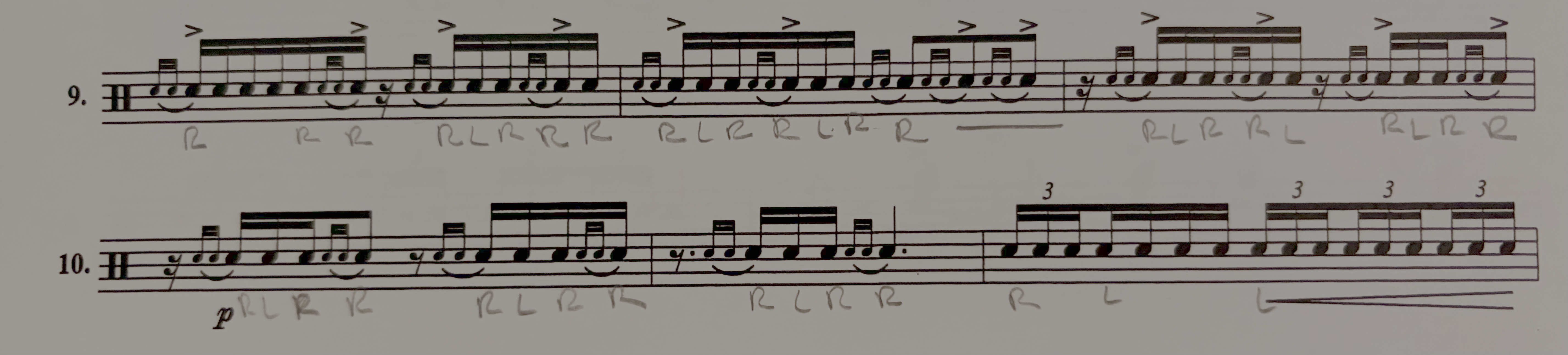
Lines 9 and 10 are considerably more demanding than the rest of the piece. This line combines the natural sticking with the same hand drag concepts and more of the double right “Scheherazade” sticking. Cirone recommends an alternating sticking in his Study Guide addition, but I disagree. The following sticking will have much better tone, but does require careful practice for the “inverted” or “whip” motion on the right hand.
Marimba: Etude #2 by Stan Dahl
This is among the more difficult etudes from previous years, especially in terms of rhythm and note accuracy at the marked tempo. Start slow and be very deliberate about practicing accurately with a metronome.
Primarily this etude is about STYLE. Style is:
- Timing
- Accent
- Balance
First section: Freely, with expression
Timing: This is a lyrical melody, meaning it conforms to the voice. After you know the notes, SING the phrases and let your voice and breath tell you where to flex the rhythm. Practice by first playing 16th notes through the line as a rhythm. This teaches you what the exact rhythmic pacing is, with no “unintended flexibility” due to rolling alternations.
Accent: There are no written accents. The line CAN follow the general rule “notes going up get louder, notes going down get softer” and phrase comfortably, however, so an emphasis on the top notes of each phrase is appropriate.
Balance: When the left hand enters as harmony in m5 it’s important to keep the melody from being covered. Move the mallet in the left hand close to the ropes on the bars to reduce the resonator response so the melody is clearly heard. In m7 I pull back from the rope a bit when the left hand has a phrase to bring that voice out.
Second Section: Lively
Timing: Totally straight to the metronome. Never practice this without a metronome. This is the most challenging section, full of “gotcha” moments. Be sure the triplets fill up the space they are in and have a smooth, slurred feeling compared to the surrounding 16ths.
Accent: This is in a Caribbean/Latin style, so the off-16th notes often get emphasis. Many of the phrases begin on an off-16th to highlight this. Rolls which are accented can be started with the top note, which will give them a little extra “pop”.
Balance: The dynamics act as voices, almost like playing a reduction of a band arrangement. Assign contrasting dynamics as voices, and change not only the volume, but the character of sound, especially in m20-25.
Third Section: Relaxed
Timing: Again, straight to the metronome. I suggest practicing with a soft 8th or 16th note to ensure clean execution of the syncopations. Cover the quiet metronome as you play so the clicks are only audible in the spaces between notes.
Accent: No marked accents. A bit of emphasis can be added on the crunchier chord changes. m32, m37, and m38 are good places to lean slightly on the dissonances.
Balance: Every note in every chord is evenly balanced. No emphasis within a chord.
Miscellaneous notes: These interpretations are demonstrated in the recording.
- m18 is weird. Learn it carefully with a metronome. Soften the roll release on the first note on beat four. This sets up the phrase beginning as an off-16th pickup into beat one.
- Rolls in m17, m19, and m24 can release earlier than marked for clarity. I release them on an 8th or 16th like a hard release a wind player might use.
- m27-28 is really hard to navigate. Begin by LIFTING the mallets away very high to avoid getting tangled up near the bars. Play it totally flat with no accents until it is up to tempo, then add a slight push with the arm on the first note of each grouping. Do not increase the stroke speed to get the accent.
- The rising line in m28 is an Ab diminished chord with a “gotcha” A at the top
- Practice this with funny rhythms. Swing it, group quick bursts of 2 and 3 notes, anything you can do to twist it and force your hands to adapt. Simply playing it as written over and over will result in very little progress.
Timpani: Etude #6 by Barry Dvorak
A typical assortment of cross-sticking and rhythm changes, but with the added challenge of producing a clear tone with brushes and wood mallets.
Drum Sizes: I recommend the top three drum sizes, 29″, 26″ 23″. This is will put the pitches in the low range where they will be more resonant with the brushes and wood.
Tuning: Starts F C E, goes to G C G.
- Set C first.
- Sing that C into the low drum and pedal from the bottom, the 5th harmonic will sing back at you and then it’s mostly in tune.
- Sing the C again and use a song like “3 Blind Mice” to get the high drum
- C is “mice”, E is “Three” in the song.
- A Major 3rd needs to be 14 cents flat to be truly in tune. Be very careful not to set it too high.
- For the second set of pitches keep the C and sing a G into it. That 5th harmonic will sing back when it’s exactly right.
- Keep singing that note and move to the top drum, then the bottom.
I strongly suggest marking gauges with these pitches. They are not allowed for the audition but you can use the markings to memorize pedal positions as you practice. Go back and forth and double check the tuning over and over until you can quickly hit the changes without needing any extra reference pitches. At most tap with your fingers to confirm the pitches as if you were trying to stay silent in a performance.
Brushes: I recommend a “Steve Gadd” type of brush, with the last 1.5 inch bent slightly. This can be bought from Vic Firth or made from straight metal brushes by pinching the ends with a needle nose pliers and pressing them gently on a table.
Wood Mallets: I recommend the smallest mallet heads possible. I recorded with very small headed mallets from Tom Freer, but the Haas wood mallets from Promark or the general wood mallets from Vic Firth would be a good option as well.
First Half – Brushes:
- Dynamic is mp. The brushes will basically take care of the dynamic, as they will not be very loud. There are no phrase indications, so to add line and direction a good option is to give the subdivisions differing weight and character.
- 8th notes and larger are the heaviest and choppy
- Triplets are lighter and flow more smoothly
- 16ths are lighter still and have a quick, bright feel
- 32nds are the lightest and are basically grace notes
- Stickings are all over the place. Check the video for specific solutions, don’t hesitate to use crosses or doubles anywhere as long as the tone is consistent.
- I recommend dampening the last measure as follows:
- Dampen the top drum as you play the last note /w Right Hand
- Dampen the bottom drum right away after /w Left Hand
- Dampen the middle drum on the 8th rest as indicated /w Right Hand
Second Half – Wood Mallets:
- Dynamic is f. Wood mallets will again take care of the dynamic, just play light and consistent. Same phrasing ideas as in the first half.
- Stickings are still all over the place. I start this LR LRLR, with beat two as a cross over. The rest is pretty negotiable, many ways to do it as long as the tone is steady.
- I recommend dampening the last measure exactly as before.
Crash Cymbals: Aaron Williams Etude #8
This is a tough one. Set a metronome to eighth note = 272 and clean the rhythm of each measure with hand claps before even picking up cymbals.
There are four dynamics indicated. f should be comfortable, as it requires the most dampening and needs room for accents. mf is a mellow version of the same thing. p is very light with an emphasis on moving slow for a low tone. The ff in the last bar needs to be deeper than f for an obvious contrast.
A reliable way to get these dynamic changes is to feel the weight moving from the fingers at piano, then from the hands, the front of the forearms, and the forearm from the elbow as the dynamic increases. This weight emphasis keeps you from using too much stroke speed and overblowing the cymbals, and gives you better depth of tone.
I do recommend learning the whole piece at p, then playing mf at all dynamics above p, then f above that, then finally adding ff. This will give you a higher degree of control at each stage, and train your ear to separate the cymbal tones more precisely.
Tambourine: Aaron Williams Etude #8
Tricky dynamics. I look at them more as accents than dynamics, and that makes it easier to see what to do. First of all, set yourself up with a stand between you and the judge so the loud/soft roll effects at least seem to work a little better.
Starting in m3 I rest the tambourine on my knee and play directly opposite where it touches. This reduces the sound the most for a stable, low pp. I then play the f notes in bars 3-4, and 7-9 with an Up/Down motion from hand to knee, sticking to my knee at the end to set up the next pp note.
The finger roll in m5-6 is a bit misleading. There is no way the ff on that roll will match the ff from bar one, so don’t try. SHOW a big start to the roll and hold that big tone before lowering the dynamic as you lower the tambourine to your leg. It’s very helpful to put marks along the edge of the rim so you know where to start, how many marks you cover before reducing your dynamic, and where to end. This builds in an element of consistency which is often overlooked.
The shake roll in m10 is also a bit misleading. It’s really hard to start a shake roll soft. Get a good tone and SHOW the dynamic by starting low and raising the tambourine through the crescendo. The stand blocking or appearing to block some of the sound helps this to work.
m12 to the end is really fast. If you can play all the 16ths with a fast single stroke that’s fine. If you need to use a knee/fist thing that’s fine. I use a heel/toe/toe type motion I developed from conga and pandiero playing. It works great for me but I can’t recommend one method over another. You need to experiment. I accelerate my accent in m14 for more impact and then open my hand to slap the last note. The slap could be a closed knuckle knock as well.